Report from the march to Stop the AI Race
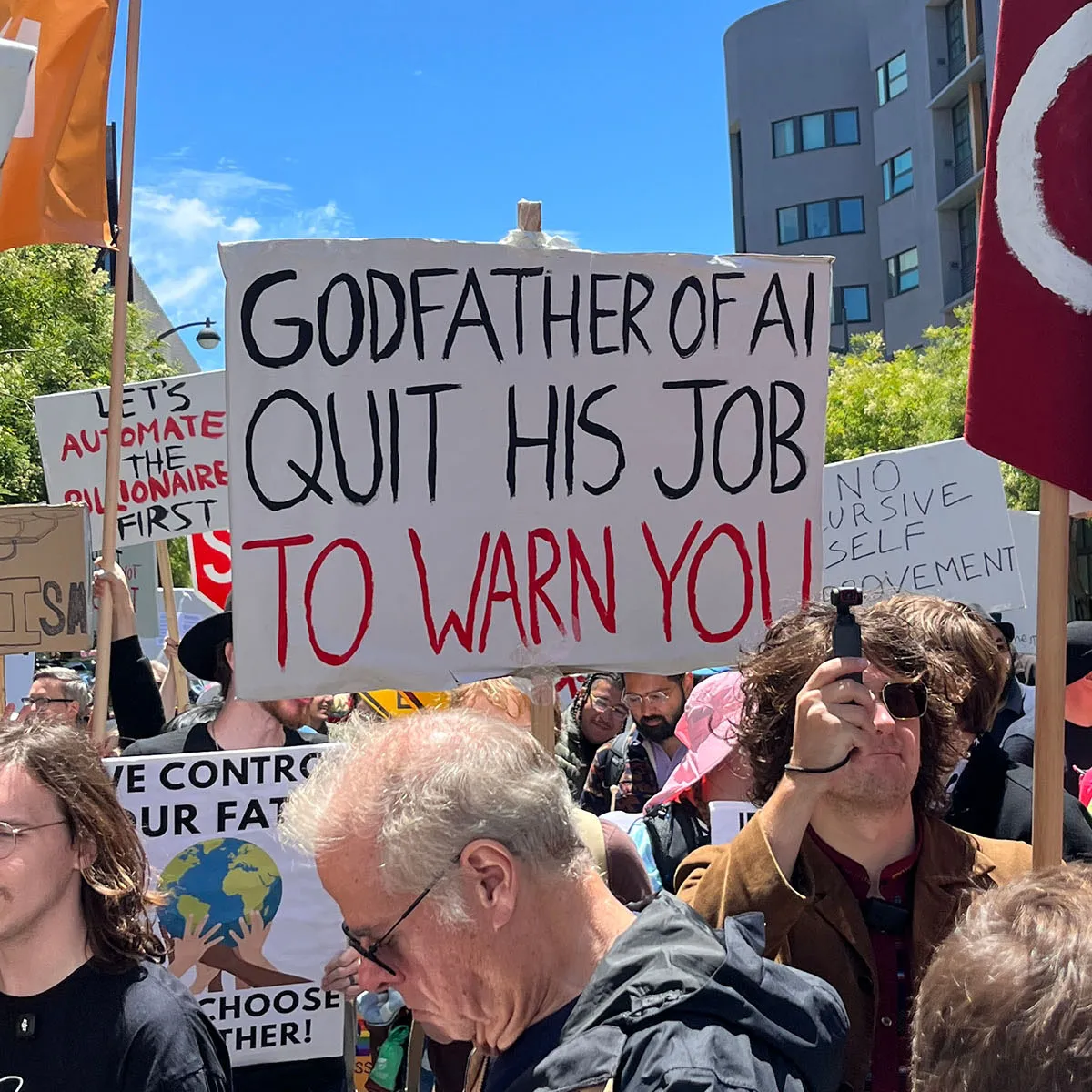
On Saturday, beneath a sparkling blue sky, I joined the march to Stop the AI Race. We gathered in front of OpenAI’s office in Mission Bay, then walked through the city to Anthropic’s HQ beside the Transbay Transit Center.

If this had been a march organized around the diffuse concept of “AI BAD”, I wouldn’t have joined. But I am just so impressed by the elegance of Stop the AI Race’s demand:
Every major AI lab CEO must publicly commit to pausing frontier model development if every other major lab in the world credibly does the same.
Like, how rare is this?? A protest movement with (1) an actual objective, that (2) could conceivably be met. As much as anything else, I came out in support of simplicity and clarity.

But I also believe that the world would benefit from a pause in frontier model development. The weird thing about this debate is that no one, not even the most hyped-up accelerationist, disagrees about the situation:
- Here is a powerful technology,
- operating in a way that no one really understands,
- with profound effects on the economy, not to mention human psychology,
- that are very difficult, maybe impossible, to make plans around.
For my part, I look at that fact pattern and think: uh, yes, this merits great caution and deliberation! Measured, I would say, in countries and years, not “model cards” and weeks. And my response isn’t reflexive, but deep-rooted —
This isn’t a call to outlaw language models. It has been widely observed —
I’ll direct your attention to the language of a recent post from the Anthropic Institute. It’s encumbered by a few extra clauses, but the spirit of Stop the AI Race’s demand shines clearly through:
We believe it would be good for the world to have the option to slow or temporarily pause frontier AI development to enable societal structures and alignment research to keep up with the advance of the technology. The Anthropic Institute will conduct research —
in collaboration with many others — and take actions to help build the systems that a credible slowdown or pause would require. These systems would enable frontier AI developers to verify that others globally have actually stopped or slowed, and that a bad actor could not use the auspices of a coordinated slowdown to jump ahead in secret. If such systems existed, we expect that we would slow down or temporarily pause, if other developers at or near the frontier also did so in a verifiable manner.
Even if the danger isn’t as existential as the doomiest doomers imagine (I spotted these two in attendance) I believe this is a great opportunity for humanity to prove that we can actually make choices about the development and deployment of powerful technology. If we can’t, then we are not as sovereign as we imagine; if we can’t, a machine god has already taken over this planet, and it’s called the market.
A pause isn’t impossible, and powerful, unpredictable AI is (as a gorgeous blue banner at the head of the parade declared) not inevitable.
This whole thing was better than I expected: a big crowd, numbering in the low hundreds; a great vibe, goofy and polite; perfect weather, never assured in San Francisco in July; and a marching band! We love a marching band. (Who paid for the marching band … ?)
And, of course, it’s worth appreciating, here and now in this country’s 250th summer, that we can still do things like this. Raise a mild ruckus, take up a bit of space, walk in the middle of the street. As we marched past Oracle Park, there was a Giants game underway, and it occurred to me that the great majority of the fans inside agree with the argument of this protest much more than they agree with the objectives of the AI companies. Democracy stirs —
From the streets of San Francisco —
