Energy suck
The concrete is flowing in Abilene:
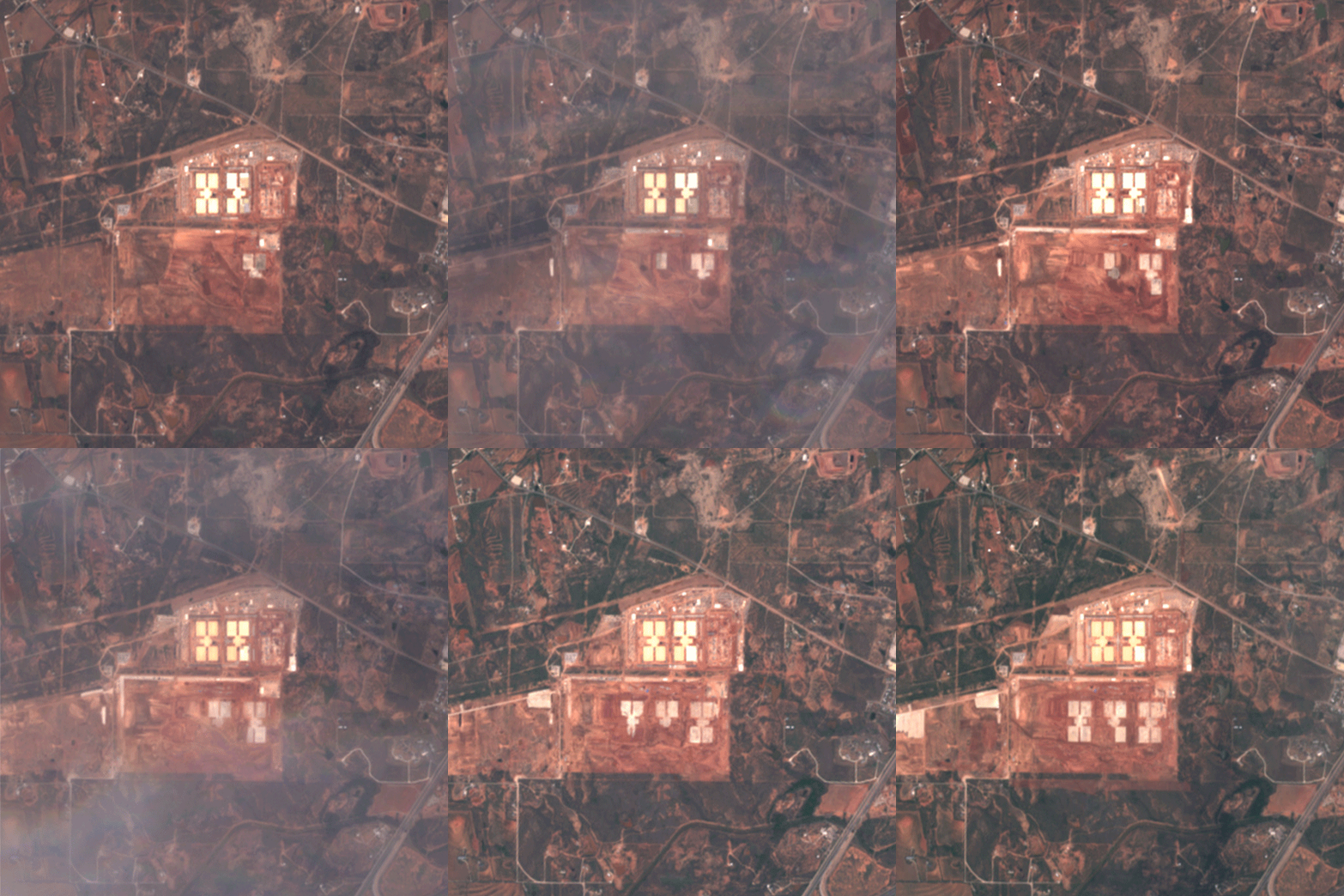
That’s the first Stargate data center, intended for OpenAI’s use, captured by the Sentinel-2 satellites between March 7 and April 14: a little over a month of work. The sense of urgency is palpable, even from space!
It’s ironic that, just as engineers broke the curve of energy efficiency, producing chips (like Apple’s M series) that yanked the Pareto frontier of power vs. energy into undreamt-of territory, the software industry found an outlandish new need for raw compute.
It’s tempting to say “this always happens”—humans are always discovering new needs, new desires, right? —
By the mid-2010s, a surprising picture was coming into focus, driven by the requirements of mobile phones: a world of super-powerful devices consuming energy in dainty sips. Just like the cameras on those phones, there seemed to be something physics-breaking about it —
And then came AI.
In fairness: first it was AWS, then GCP and Azure and all the rest. Then, having perfected the design for this kind of facility —
The [Department of Energy] finds that data centers consumed about 4.4% of total U.S. electricity in 2023 and are expected to consume approximately 6.7 to 12% of total U.S. electricity by 2028.
This is a wild trendline!!

The loads produced by data centers are weird, in the sense that they are steady, day and night; nearly every other load (including industrial loads) has some kind of cyclic pattern. This is causing new problems for some power grids.
In your imagination, copy and paste the satellite imagery above across the U.S.: Louisiana farmland, Nebraska cornfields, Arizona desert … Everywhere, the concrete is flowing, and soon the server racks will sprout. Another cool billion for Nvidia’s 10-K, and another, and another.
The AI data center buildout seems wasteful to me because it’s duplicative: a bunch of companies all racing to acquire exactly the same thing. Imagine another timeline, in which a stable, savvy U.S. government declared AI research a national priority and organized an ambitious project to pursue it: bringing investigators together into super-powered labs, funding the construction of national data centers, making them available to academic researchers —
(Remember, the true sublime of the Manhattan Project wasn’t the science camp at Los Alamos: it was the pop-up uranium and plutonium enrichment facilities, doing exacting chemical work at basically inconceivable scale. If you are looking for “state capacity”, there it is.)
A clear remedy to the moral problem of a technology built on the commons would be the commitment of these tools and research, plus their outputs, back to the commons.
This is a scenario held in wistful regard by plenty of folks in the AI industry, by the way.
Of course, there’s a response that goes: “Let us cook —
It feels totally appropriate to say to OpenAI, Google, and the rest: sure, build all the data centers you want … just be sure to budget for the solar farms and batteries to support them.
There’s room for big concrete boxes in this world —
The laptops these days run without fans, cool and quiet, faster than ever. Meanwhile, the long corridors of the data centers roar, and roar, and roar.
To the blog home page